Industrial demolition
Selective demolition
Demolition of the structures to be renewed in buildings that are being retained, from industrial buildings to public and residential buildings
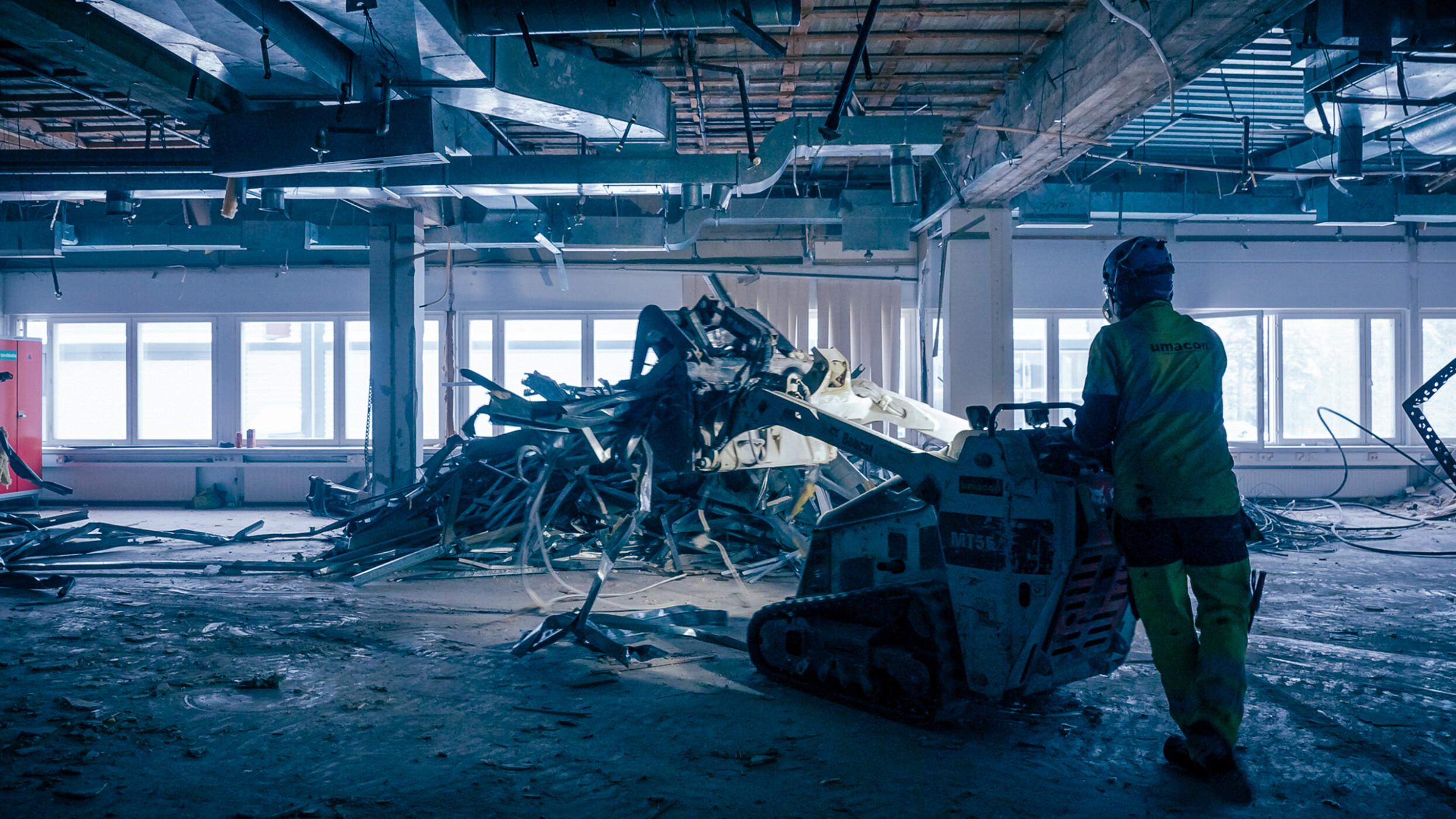
Demolition of the structures to be renewed in buildings that are being retained, from industrial buildings to public and residential buildings
When only certain structures in a building are demolished, it is called selective demolition. In some cases, selective demolition can be the most cost-effective solution, and at certain sites, such as protected buildings, it may even be the only possible option. Selective demolition removes the structures that are to be replaced, while protecting the structures being retained, which remain as part of the new whole.
Our selective demolition service adapts flexibly to the needs of your project. We can act as the management contractor for the entire selective demolition project, in which case we are responsible for the whole project, from project planning and the pre-demolition audit all the way to the demolition work, or as the main contractor or a subcontractor within a larger project. Many of our clients also choose something in between – in that case, we get involved in the early stages of the project, advising on cost-effective and efficient solutions for the demolition work.
Building demolition is treated in the same way as construction and is subject to Finnish land use and building legislation.
Selective demolition is a multi-stage process that requires careful planning and seamless coordination of the demolition stages. Several factors have to be taken into account at the same time during the work, such as protecting the structures being retained, the safety of the site and its surroundings, keeping passers-by and others operating in the area informed about the different stages of the demolition, enabling the reuse of demolition materials, efficient recycling and compliance with building legislation. Successful demolition requires not only strong technical expertise and precise advance planning, but also the ability to respond flexibly to changes during the project.
Our selective demolition service adapts flexibly to the needs of your project. We can act either as the management contractor for the entire selective demolition project, in which case we are responsible for the whole project, from project planning and the pre-demolition audit all the way to the demolition work (see option 1), or as the main contractor or a subcontractor within a larger project (see option 3). Many of our clients also choose something in between – in that case, we get involved in the early stages of the project, advising on cost-effective and efficient solutions for the demolition work (see option 2). Involving the demolition contractor as early as the planning stage can significantly improve the project’s efficiency, as we have the expertise and solid experience of carrying out many different kinds of building demolition in practice.
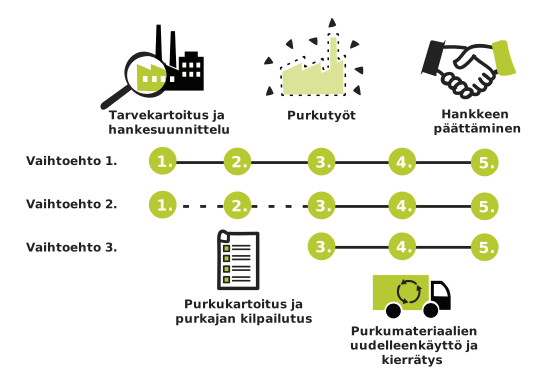
Selective demolition always begins with identifying the client’s needs and objectives and planning the project carefully. At this stage, the key requirements of the project are defined, such as the purpose of the demolition, the structures to be demolished and retained, the schedule, the cost estimate and the opportunities for reusing and recycling demolition materials.
We understand that in the early stages of a project, the key questions are often the cost of demolition, its environmental impact and any structural challenges. As early as the needs assessment stage, we help assess the costs of the demolition project, the potential for reusing and recycling demolition materials and the execution of structurally challenging sites. Our expertise and experience of challenging selective demolition projects support cost-effective, practical and well-planned project delivery right from the start.
Once the client’s needs and objectives have been defined, project planning moves on, depending on the project, to preparing a voluntary pre-demolition audit. The pre-demolition audit builds a comprehensive overall picture of the demolition site, the demolition materials, and the starting points, constraints and details of the demolition work. The information in the pre-demolition audit provides a good basis for the construction and demolition waste notification that is prepared in connection with the building or demolition permit.
The pre-demolition audit assesses the quantity and quality of the materials that demolishing the building will generate, identifies building materials and fixtures suitable for reuse as they are and materials suitable for use as secondary raw materials, and makes a recommendation for recycling the materials. If necessary, a hazardous materials survey, which determines the quantity, location and quality of materials and structures containing hazardous substances and gives instructions for their safe removal, is also carried out before demolition. After the pre-demolition audit, the client selects the demolition contractor best suited to the work.
Once the client has chosen a demolition contractor, the contractor draws up a demolition plan for the execution phase, which is reviewed together with all parties to the project. In the demolition plan, we define, for example, the structures to be demolished and retained, the schedule, the work stages, techniques and equipment, health and safety measures, and how demolition materials will be sorted for reuse and recycling. Before demolition work begins, the client must also apply to the building control authority for the demolition permit required by law, after which demolition work can start.
We start the demolition by protecting and fencing off the retained structures of the building being demolished and its surroundings, and by preparing the practical side of the site, such as logistics. Before the actual demolition work begins, we go through the site safety rules and instructions with everyone involved, and we also inform any local residents and others operating in the area that demolition work is starting.
Demolition proceeds in stages, from smaller structures to larger ones and from the inside out. We first remove the structures and fixtures that are suitable for reuse as they are, after which, depending on the site, we carry out any asbestos and hazardous materials removal and interior strip-out required.
In demolition projects, there may be situations where, despite careful planning, the parties to the project are unable to assess the scope of the demolition work down to the smallest details, such as every structure on the site. In such situations, we act flexibly and in close cooperation with all parties to ensure that the project progresses smoothly and without unnecessary delays for the client.
We carry out all our demolition work with on-site sorting, which means that we carefully sort demolition materials as the work progresses.
We carefully dismantle building materials and fixtures that are suitable for reuse as they are and, depending on the client’s wishes, deliver them for the client’s own use, to our second-hand resale service or to a circular economy operator that handles the resale of reusable products.
Depending on their quality, we direct other demolition materials either to use as secondary raw materials or to recycling. For example, we can process the concrete from demolishing the structural frame into crushed concrete that suits the client’s needs, such as for use in earthworks. We deliver all other demolition materials for recycling to recovery facilities designated for each material fraction.
A successful demolition project concludes with all parties to the project confirming that the work is complete. When the demolition work is finished, we provide our client with waste transfer documents, which record the transport and treatment of the demolition materials as required by law, and waste reports summarising the demolition materials and their reuse and recycling. We also take care of the necessary notifications to the authorities and the related procedures. At the client’s request, we also report the demolition project’s recovery rate and carbon footprint.
At the end of the project, we hold a final inspection at which we go through the details of how the project was carried out together with all parties. At the same time, we make sure that we have carried out the work as agreed and met our client’s expectations.
Selective demolition requires particular precision, because the demolition takes place at the interface with the structures being retained. We plan every stage of the work carefully so that the retained structures are not damaged during demolition. Skill and patience are also needed, especially at sites where the age of the building, its structures or other characteristics place special demands on the project. Taking these requirements into account and carrying out the work carefully ensure that the project succeeds without extra risk.
“We have carried out selective demolition in blocks of flats undergoing major renovation and even in the historic 19th-century Finnish National Theatre. Because every site is unique, we always plan the work stages around the specific features of the site,” says Umacon’s Production Manager Antti Lantta.
We reduce the use of natural resources by maximising the recovery rate of the demolition materials generated by our building demolition projects, getting it as close to 100% as possible.
We aim to dismantle materials that are suitable for reuse as they are, keeping them intact. For example, we salvage exterior and interior windows, stairs and various fixtures and put them back into circulation. We also maximise the recovery of the project’s other demolition materials by sorting them on site as the demolition work progresses. Each material fraction is collected separately, which significantly reduces the amount of waste going to landfill and lowers the project’s waste costs. The most common waste fraction in building demolition is concrete or brick, from which we can produce crushed concrete for use as a secondary raw material at the client’s request.
In 2024, our recovery rate was as high as 99.88%, which means that only 0.12% of our demolition materials went to final disposal.
Contact us in whatever way suits you best and we’ll get back to you as soon as possible. Our experienced project managers are there to support you, even if your demolition project is still on the drawing board.
"*" indicates required fields

Our Massive Force is built on our top-class equipment and decades of expertise. We demolish even the largest structures in a controlled way, as if they were Lego bricks.

We’re not immune to hazardous materials, but we know exactly how to handle them safely.

There’s nothing magical about our risk management – it’s based on careful anticipation and nearly 40 years of experience in challenging working environments. We spot risks before they arise and ensure safety on every project.

Safety is our number one priority. We don’t have an invisible force field, but our commitment to health and safety ensures that everyone on site and in the surrounding area stays safe.

We can’t control time, but we arrive at lightning speed and work whenever you need us. We demolish in record time, even round the clock, if it means we can spare you the costs of a production stoppage.

In every demolition material, we see the raw material of the future. We maximise the recycling rates of our demolition projects to nearly 100%.

We became demolition contractors, not bankers – but we handle materials worth millions as if they were our own. Everything of value stays safe throughout our projects.
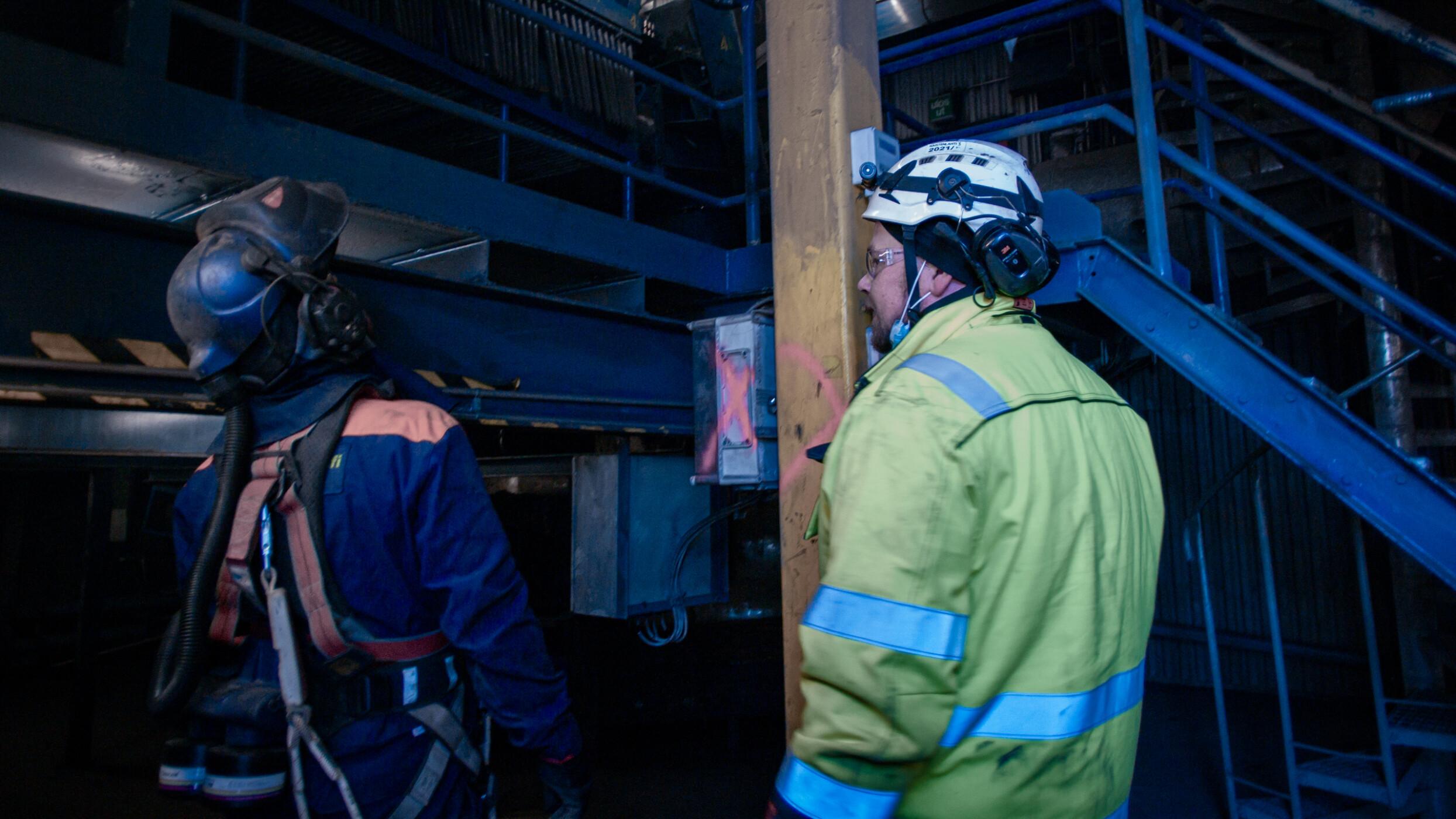
A controlled, cost-effective demolition project from start to finish, in line with your goals.